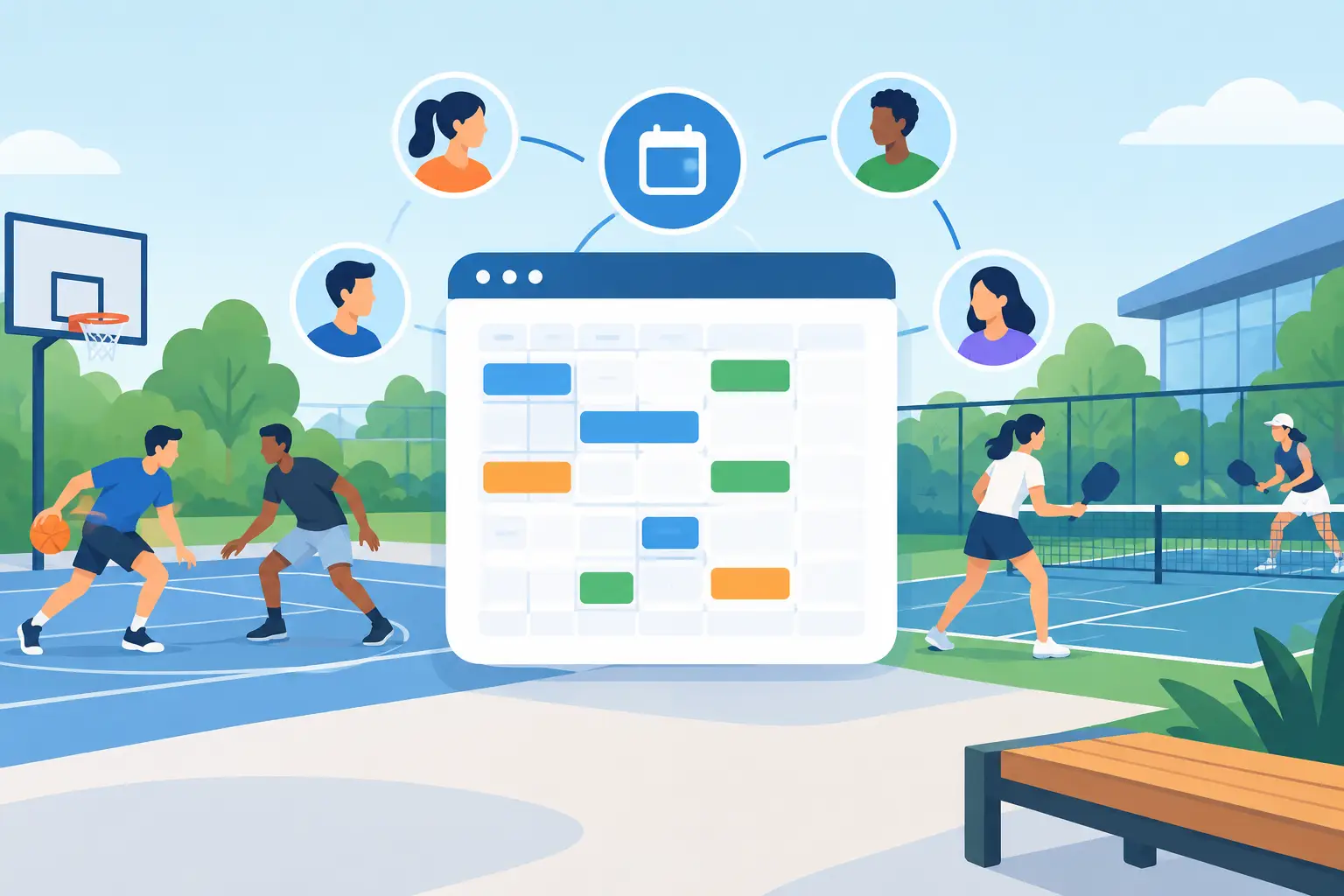
A court can look available on a calendar and still be impossible to use. A coach may be finishing a lesson, a league match may run long, maintenance may need access, or two captains may believe they reserved the same time. Shared space scheduling turns those everyday facility pressures into clear rules, visible availability, and dependable player access.
For sports clubs, parks departments, academies, and HOAs, this is not just a calendar problem. It affects revenue, member satisfaction, staff workload, and whether players can get on the court when they are ready to play. The goal is simple: keep every valuable space active without creating friction for the people who use it.
When Shared Space Scheduling Breaks Down
Most scheduling problems begin with disconnected processes. A front desk team tracks courts in one system, coaches manage lessons by text, league captains hold recurring time on a spreadsheet, and players call or message to ask what is open. Staff members become the bridge between every request, which works only until the facility gets busy.
The result is familiar: double bookings, unused reserved time, disputes over priority, and frustrated members who see an open court but cannot tell whether it is actually available. Manual coordination also makes it harder to answer basic operational questions. Which courts are most used? Are prime hours going to paying members, programs, or no-shows? Is a tournament blocking more time than it needs?
A good system makes availability trustworthy. That means the same schedule must account for open play, private lessons, group clinics, league fixtures, tournaments, maintenance blocks, and special events. If a space is unavailable, players should know why. If it is available, they should be able to reserve it without waiting for a staff member to confirm the details.
Build Shared Space Scheduling Around Real Play
A court scheduler should reflect how your facility actually operates, not force staff and players to work around generic calendar rules. Start by defining what can be booked: individual courts, fields, batting cages, studios, meeting rooms, equipment, or any space with limited capacity. Then define how each resource is used at different times of day.
A pickleball club may allow members to reserve a court two weeks ahead, while limiting guests to seven days. A tennis academy may reserve after-school hours for junior programs and give coaches protected lesson blocks. A parks facility may need public drop-in windows, permit-based reservations, and seasonal league allocations. These policies should be visible in the booking experience, not stored in a staff handbook.
Set booking rules players can understand
The best rules are firm enough to protect access and simple enough that players do not need to ask for an exception every time. Decide how far ahead each audience can book, how many active reservations one person may hold, the length of each reservation, and the cancellation deadline.
There is a trade-off between flexibility and fairness. Letting members reserve months ahead can support planning, but it can also allow a small group to dominate prime time. Very short booking windows create equal access but may frustrate families, teams, and coaches who need certainty. Many facilities use different windows for different memberships or program types, then review usage data to see whether the policy is working.
Consider transition time, too. A 60-minute reservation does not always mean 60 minutes of play. If players need to check in, set up equipment, or clear the court before the next group arrives, build an appropriate buffer into the schedule. Small gaps can protect the player experience and reduce conflict during busy hours.
Give programs protected space without hiding it
Lessons, leagues, tournaments, and clinics are often the heart of a club's business. They should not compete invisibly with member bookings. Block the required space on the same calendar players use, with a clear label such as “Junior Academy,” “League Match,” or “Tournament Play.”
That visibility matters. Players are more likely to accept unavailable time when they can see the activity taking place. It also helps them plan around programming instead of calling the front desk to ask why courts disappeared from the schedule.
For recurring programs, use repeating reservations but revisit them regularly. A league that needs four courts every Tuesday in spring may need fewer in summer. A coach's standing lesson block can become wasted capacity if it stays protected after demand changes. Recurring reservations save time, but they should not become permanent claims on your best inventory.
Connect reservations to payments and check-in
A reservation is more reliable when it carries the full transaction with it. If a nonmember fee, guest fee, lesson charge, or event payment applies, collect it during booking or clearly show what is due. This reduces awkward follow-up and gives players confidence that their spot is confirmed.
Check-in closes another common gap. When players check in from a mobile app or at the facility, staff can see who arrived, who canceled, and which spaces went unused. Over time, that information helps you set smarter cancellation policies. A club with frequent prime-time no-shows may require confirmation, apply a late-cancel fee, or release unclaimed courts after a defined grace period.
The policy should fit the community. Heavy penalties can discourage casual participation, especially at public facilities or neighborhood HOAs. But no consequence at all can make it easy for people to hold space they do not intend to use. Clear expectations, reminders, and consistent enforcement usually work better than punitive rules.
Make the Calendar Useful for Staff and Players
Players need a fast path to booking. They should be able to see available spaces, select a time, add participants when needed, pay if required, and receive confirmation from their phone. Captains need a way to reserve team practice or coordinate league participants. Coaches need visibility into lesson availability without manually checking every court schedule.
Staff need a broader view. They should be able to block facilities for weather, maintenance, or an event; adjust a reservation when a match runs late; and see who is using each space. They also need permission controls. A player should not be able to override a tournament block, while an authorized manager may need that ability when conditions change.
This is where an all-in-one operational environment earns its place. When reservations connect to memberships, payments, leagues, coach schedules, event calendars, and player records, staff stop re-entering the same information across separate tools. A2M Sports helps clubs organize those connected workflows in one place, so a booked court can support the full experience around it.
Use Data to Protect Revenue and Access
Once scheduling is centralized, the calendar becomes a source of operational insight rather than a record of past bookings. Look beyond total reservations. Compare booked time with check-ins, identify peak demand by day and hour, and measure how often spaces are released through cancellations. Review program blocks against actual attendance, especially during high-value evening and weekend periods.
These patterns can guide practical decisions. If weekday mornings are consistently open, create an open-play session, senior program, or discounted booking option. If Saturday afternoons fill instantly, consider shorter reservation limits, a waitlist, or more structured play. If coaches need more space than expected, adjust the mix of lesson blocks and member access rather than relying on last-minute staff decisions.
Do not optimize only for maximum court utilization. A completely packed schedule can leave no room for weather adjustments, spontaneous play, or event overflow. The right balance depends on your facility model, membership promises, staffing, and community goals. Revenue matters, but so does making members feel they have a real chance to participate.
Start With Your Busiest Time Block
You do not need to redesign every reservation rule at once. Start with the period that creates the most friction, whether it is weekday evenings, weekend mornings, or tournament days. Map every current use of the space, identify where conflicts occur, and turn the informal decisions staff make every day into visible scheduling rules.
Then communicate the change in player language: when they can book, what happens if plans change, and where they can see program availability. When the calendar is clear and the rules are consistent, players spend less time negotiating access and more time playing. That is the kind of organization a sports community feels immediately.