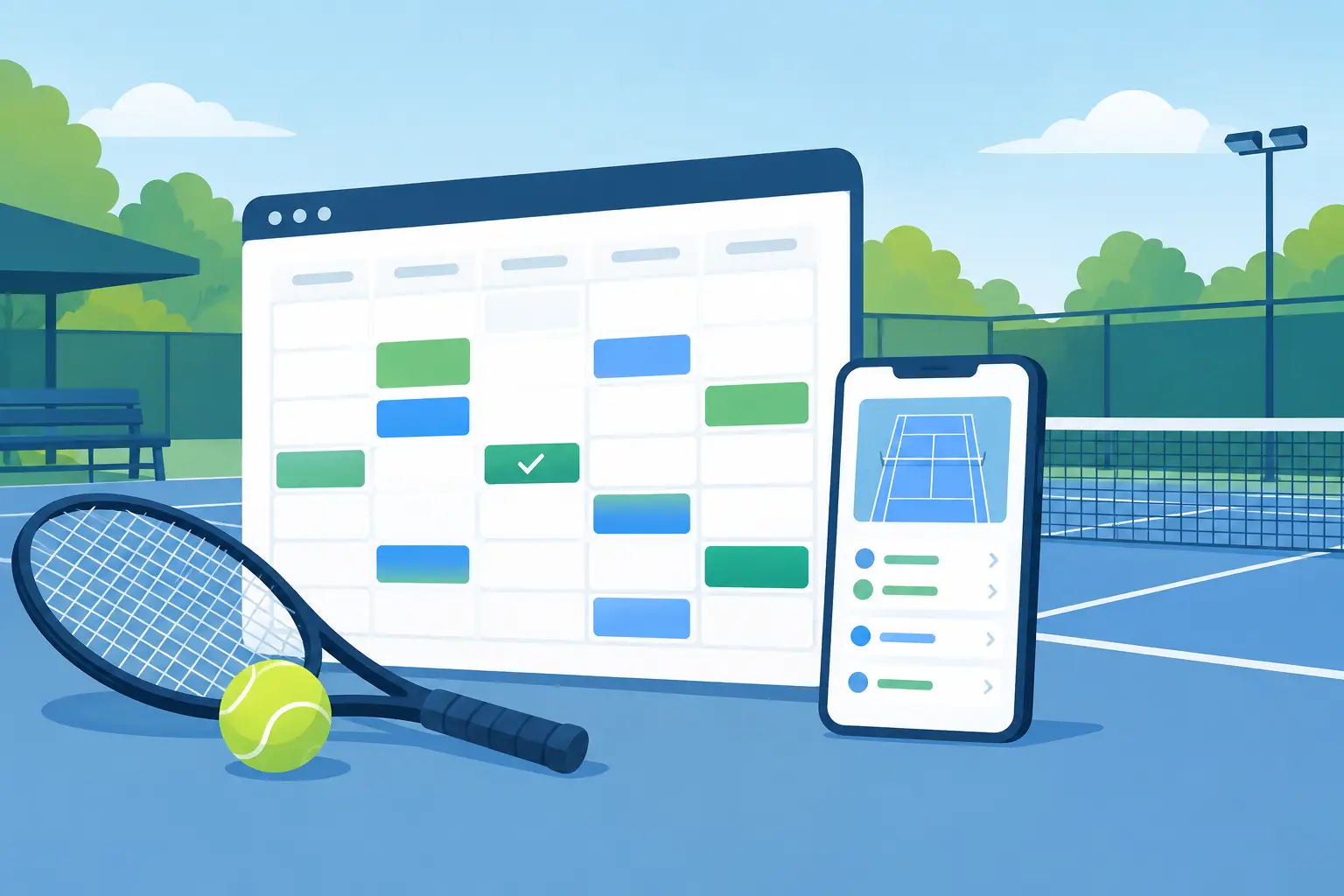
At 5:40 p.m., the front desk should not be untangling a double-booked court, chasing a guest fee, or explaining why a member cannot find an open slot. The top court scheduling features turn those high-pressure moments into a clear, self-service experience for players and a more organized operation for your club.
For clubs, racquet academies, parks departments, and HOAs, a court calendar is not just a calendar. It controls access to one of your most valuable assets. The right system helps members get on court, gives staff the rules and visibility they need, and connects reservations to payments, programs, coaches, and events all in one place.
What Top Court Scheduling Features Should Do
A scheduling tool can look polished and still create extra work if it only shows open times. Strong court scheduling software needs to understand how your facility operates. That means it should apply booking policies automatically, account for different court types, and make it easy for players to complete a reservation without staff intervention.
The best setup depends on your operation. A private tennis club may prioritize member booking windows and guest controls. A busy pickleball facility may need frequent rotation, waitlists, and clear visibility into Rec Play. A parks and recreation facility may need public reservations, permit rules, and payment collection. The foundation is the same: every reservation should follow your facility's rules before it reaches the court.
Real-Time Availability Across Every Space
Players expect to see accurate availability before they commit to a visit. A useful scheduling system displays courts by location, sport, surface, and time, then updates availability immediately when someone books, cancels, or checks in.
This matters beyond tennis and pickleball courts. Many facilities also schedule ball machines, meeting rooms, fitness spaces, practice fields, or shared event areas. When these resources live in separate calendars, staff become the connection point. A unified view lets operators manage the entire facility without bouncing among spreadsheets and disconnected tools.
Clear availability also helps players make decisions faster. Instead of asking the front desk which court is open, they can filter options, select a time, invite other players, and receive confirmation on mobile. That is better service without adding another task to your team's day.
Configurable Booking Rules That Protect Access
Open booking works for some facilities. Most need more structure. Court scheduling should let you set rules around who can reserve, how far in advance they can book, how long they can play, and how often they can hold prime-time slots.
For example, members may receive a seven-day booking window while nonmembers can book three days out. A court could have a 90-minute maximum during evening demand, then allow longer reservations during slower weekday periods. You may allow each player one advance reservation at a time or restrict consecutive bookings when others are waiting.
These rules should be flexible rather than one-size-fits-all. Junior programs, league matches, private lessons, and open play do not need the same reservation policies. Good software lets operators apply different settings by court, membership type, activity, and time of day. Players see the rules before booking, which reduces uncomfortable conversations at the desk.
Payment, Membership, and Access Need to Work Together
A reservation is only part of the transaction. Clubs lose time and revenue when court fees, guest charges, and membership status must be checked manually after a slot is booked.
Automated Fees and Guest Charges
The platform should calculate the right charge as part of the reservation flow. A member booking a standard court may pay nothing, while a guest booking or premium-time reservation may trigger a fee. The player should know the amount before confirming, and the payment should be recorded automatically.
This approach is especially valuable for pay-and-play facilities. Rather than relying on staff to collect money at arrival, the system can require payment at booking. It creates a cleaner record for the club and a clearer experience for players.
Guest management deserves the same attention. A member should be able to add a guest, enter required details, and pay the appropriate guest fee within the reservation. Operators can then set limits on how often a guest may visit or whether guests are allowed during particular hours. That protects member access while keeping the process welcoming.
Membership-Aware Scheduling
Membership should be more than a name on a roster. It should shape what each player can see and do. When a membership expires, changes, or has an unpaid balance, access rules can respond automatically based on the club's policy.
This is where disconnected software causes friction. A member database in one system, payments in another, and court reservations in a third creates gaps that staff have to monitor. Connected membership and scheduling tools reduce those gaps. Players receive the access their membership includes, while operators retain control over exceptions and account status.
Features That Keep Courts Full and Conflicts Low
Even the best booking rules cannot prevent every change of plan. Players cancel, weather shifts, coaches reschedule, and leagues take over courts. The top court scheduling features make those changes visible and manageable instead of letting unused court time disappear.
Waitlists and Cancellation Controls
A waitlist gives popular time slots a second chance to become productive. When someone cancels, eligible players can be notified automatically or offered the opening according to the club's rules. That can improve court utilization without staff monitoring every cancellation.
Cancellation policies should also be clear at the time of booking. A facility may allow a free cancellation up to a certain number of hours before play, charge a late cancellation fee, or require a staff review for specific reservations. The right policy depends on demand and your community culture. A strict policy can discourage no-shows, but it should not feel punitive for players facing real schedule changes.
Check-In and No-Show Visibility
A reservation is more valuable when the club knows whether the court was actually used. Digital check-in, staff check-in, or kiosk-based check-in can provide that visibility. It helps facilities identify no-show patterns, confirm court use, and release unclaimed reservations when appropriate.
For a busy public facility, releasing a court after a short grace period may be the right move. For a private club, a softer reminder and internal tracking may fit better. The feature matters because it gives operators data to make a fair decision, rather than relying on anecdotal complaints.
Mobile Notifications That Reduce Confusion
Confirmation messages are useful. Timely updates are better. Players should receive reservation details, payment receipts, cancellations, waitlist notices, and schedule changes through the channels your organization supports.
Mobile access is particularly important for recreational players who book between work, school, and family commitments. If a captain moves a team practice or rain closes outdoor courts, participants need a prompt update. Staff should be able to communicate the change once instead of answering the same question repeatedly.
Scheduling for Programs, Lessons, and Competition
Courts are rarely used only for casual reservations. They support private lessons, group clinics, team practices, ladders, leagues, tournaments, and special events. The scheduling system should recognize that programmed activity has a different impact on court inventory.
Coach and Lesson Scheduling
A coach needs to see available courts and available players without creating conflicts with other programming. When coach schedules and court schedules are connected, a private lesson can reserve both the instructor and the court in one action.
For academies, this also makes group lessons easier to manage. You can assign courts, set capacity, collect registration fees, track attendance, and prevent a court from being accidentally offered to a member at the same time. Coaches spend less time coordinating logistics and more time coaching.
League and Tournament Court Blocks
Competitive events require a level of control that a basic booking calendar cannot deliver. Tournament directors need to reserve courts for match schedules, account for warm-up time, adjust for delays, and communicate changes to players. League coordinators need recurring court blocks that coexist with normal member access.
The trade-off is visibility. Blocking too much court time too far in advance can frustrate members. Blocking too late makes event planning difficult. A connected platform helps operators publish event calendars early, define exactly which courts are affected, and release unused inventory when possible.
A2M Sports supports this broader approach by bringing court reservations, memberships, coach scheduling, leagues, tournaments, payments, and player participation into one operating environment. That connection matters because a court booking is often tied to a lesson, a league match, a member benefit, or an event registration.
Reporting That Improves Court Decisions
Scheduling data should help you run the facility better, not simply document what already happened. Look for reports that show court utilization by day, hour, court type, member category, and activity. You should be able to spot prime-time demand, recurring no-shows, underused spaces, and program blocks that may need adjustment.
These insights can guide practical decisions. If courts are full every weekday evening but underused at midday, you may create a daytime league, promote an off-peak membership benefit, or adjust pricing. If one court consistently has maintenance-related cancellations, you have evidence for a repair priority. If guests frequently convert to members, you can measure the value of your guest policy.
The goal is not to squeeze every minute from every court. It is to create the right balance of access, revenue, organized programming, and player satisfaction for your community.
Start with the problems your staff handles most often: booking conflicts, unpaid fees, unclear guest policies, or courts blocked for programs. Then choose scheduling features that remove those obstacles at the source, so every player can spend less time coordinating and more time playing.